
George Floyd and Juneteenth Changed Us … For The Worse
An Elegy For What Once Was, But Now Is No Longer

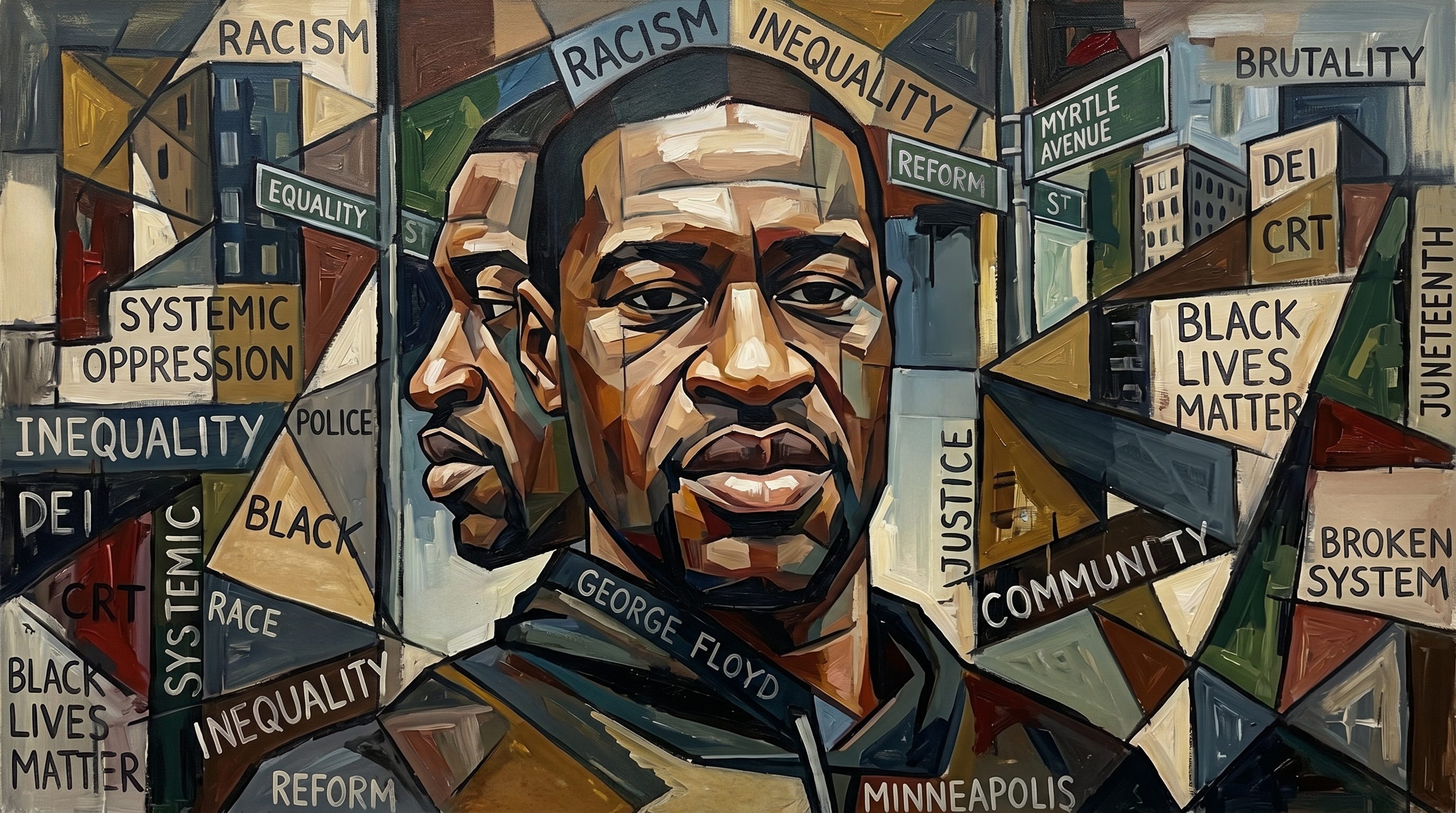
I still remember the exact moment the wall came down for me.
It wasn’t gradual. It wasn’t the result of a long theological deconstruction or a carefully reasoned political shift. It happened in 8 minutes and 46 seconds, on a street in Minneapolis, while a man named George Floyd called out for his mother, and a white police officer’s knee stayed planted on his neck until there was nothing left to call out for.
I watched it happen in real time, and something inside me that had been mortared into place over 43 years of conservative Evangelical formation cracked open like a fault line that had been building pressure for decades.
The wall came down, and I saw the horrors of systemic and institutionalized racism.
And for a moment, I thought it came down for all of us.
I thought we all saw.
The Summer We Almost Got It Right
We should be careful not to romanticize the summer of 2020, because romanticizing it is part of how we ended up here.
But something real happened in those weeks after George Floyd’s death, something I had never seen in my lifetime. People who looked like me—white, middle-aged, church-raised, politically comfortable—were in the streets… and not just in the streets of cities like Atlanta, New York, or Los Angeles, but in mid-sized cities like the one I lived in at the time and small towns like the rural one I grew up in.
Protests erupted in communities that had never once given a thought to racial justice, let alone involved themselves in it.
Confederate monuments came down.
Cities repainted their streets.
Corporate America pledged billions.
Congress held hearings with members taking a knee in Kente cloth.
Evangelical churches (real ones, the kind I had pastored over the years) were hosting conversations about race and justice that would have been unthinkable at earlier points in their history.
And Juneteenth became a federal holiday, finally.
President Biden signed it into law in June of 2021, and for the first time in the history of the United States, the country officially said: the freedom of Black Americans is worth remembering. It is worth marking and worth celebrating on a national scale.
It felt, briefly, like the Beloved Community that Dr. King had spent his life preaching toward was not some distant dream but something we could actually taste.
It felt like Pentecost. Like the Spirit moving across every tribe and tongue, crashing through every wall we had built to keep each other out. It crashed through my wall, that is for certain.
I was a changed man standing in the middle of it.
I had gone back and pulled conversation after conversation out of Black friends and colleagues I had known for years—people I thought I knew—only to discover I had never truly heard them. Their stories poured out, and for the first time I listened.
The fear.
The exhaustion.
The grief they had been quietly carrying in rooms I was also in, because I had never made it safe for them to speak.
I was gutted.
I was also hopeful in a way I hadn’t been in years.
Maybe the country was being gutted too. Maybe all of us were finally seeing what had always been there, just on the other side of our own walls.
Six Years Later
George Floyd was murdered on May 25, 2020, and the first Juneteenth was celebrated nationally in 2021.
This week, we celebrate the sixth Juneteenth.
But it is time that we be honest with ourselves about what has happened in the five years between those two dates, because pretending otherwise would be a betrayal of everyone who took to those streets, everyone who told me their stories, and everyone who believed, even briefly, that this time was different.
The wall went back up.
Not quietly, and not apologetically. It went back up brick by brick, with legislative intent and judicial precision and the enthusiastic participation of a significant portion of the American church.
And now, on this Juneteenth, it looks like the wall of separation and segregation might be climbing higher than it has ever been in my lifetime.
The Bricks Being Laid
On April 29, 2026, the Supreme Court issued its ruling in Louisiana v. Callais, and in doing so, effectively gutted Section 2 of the 1965 Voting Rights Act. The Act that was signed into law because of Bloody Sunday, the day in 1965 when police in Selma, Alabama violently attacked peaceful protestors. The Voting Rights Acts that the Supreme Court vacated was purchased with the blood and broken bones of marchers on the Edmund Pettus Bridge, most of them connected to the prophetic Black church tradition. The Voting Rights Act made possible the very representative democracy we claim to cherish, for all Americans.
The Court’s conservative supermajority dismantled it.
Justice Kagan’s dissent described the ruling’s effect plainly: Section 2 is now “all but a dead letter,” she said. The new standard requires proof of intentional discrimination in order to mount a legal challenge, a bar so high as to be nearly unreachable, because racism in 2026 has learned that to win, it must wear a suit and carry a briefcase and file legal briefs to kangaroo courts.
CNN reports we are now on the brink of the largest reduction in Black Congressional representation since the Voting Rights Act was first passed sixty years ago. Six Black House members could be gone after the midterms. Six voices. Six seats at the table that were fought for, bled for, and won through decades of political organizing and equality work.
The NAACP’s Derrick Johnson put it plainly: “What the Supreme Court has done is sanction discrimination against African Americans in the political process.”
That ruling came down fewer than two months before Juneteenth.
Think about that.
The same nation that six years ago painted “Black Lives Matter” on the street in front of the White House just told Black Americans, through its highest court, that their votes can be diluted without legal consequence. We just need to prove someone meant to do it. And good luck with that.
That is one brick.
Here is another: The National Park Service quietly removed Juneteenth and Martin Luther King Jr. Day from its list of fee-free entry days for 2026. Two federal holidays. The only two federal holidays on the calendar that specifically honor Black history and Black freedom. Removed.
Not all federal holidays. Just those two.
And they were the only days removed, while ten others (including Donald Trump’s birthday) were added.
You cannot tell me that is coincidental. You can call it administrative. You can call it a budget decision. What you cannot call it is anything other than a clear message.
Corporate America, which six years ago was falling over itself to pledge solidarity, has followed suit. Sponsors are pulling back from Juneteenth events across the country. The money that flowed so publicly and so loudly in the summer of 2020 has quietly dried up, and Black communities are left to keep the flame alive on their own , which, to their extraordinary credit and resilience, they are doing.
And then there is the classroom.
The dismantling of federal DEI programs has cascaded into public schools in ways that are still unfolding. The teaching of Black history—not a political agenda, but actual factual history—is under assault. The USC Equity Research Institute describes the anti-DEI movement as a deliberate attempt to erase the historical gains made through the Civil Rights Movement.
Erase.
Think about that word for a moment. Erase.
The Theological Problem Everyone is Avoiding
What is happening in America right now is not just a political problem, it is a theological catastrophe.
The Hebrew scriptures are obsessed—I mean absolutely OBSESSED—with memory. The command to remember appears over 200 times in the Old Testament alone. “Remember that you were slaves in Egypt,” says Deuteronomy 5:15. God did not issue that command as a footnote but as the foundation of Israel’s entire ethical framework.
You were oppressed.
You know what oppression feels like.
Therefore, you do not oppress.
Remember!
To forget is not simply to be careless. In the theology of the Hebrew Bible, to forget is to sin.
When white people dismantle the legal protections of Black voters, erase Black history from classrooms, defund the celebrations of Black freedom, and quietly remove the holidays that honor Black lives from our national calendar, we are not just making administrative, fiscal, or even political decisions. No.
We are committing an act of spiritual forgetting. We are sinning against memory, and we are willfully sinning against the image-bearers we have chosen to forget.
Every single human being (including the ones of color that our courts are busy disenfranchising) bears the Imago Dei, the image of God. You cannot simultaneously claim to honor the God who made them and work to silence their voice in the political process. The theology does not hold up any more than the logic.
And yet here we are, six years after the nation wept together in the streets, watching a church that once called itself the moral conscience of America stand largely silent while the gains of the Civil Rights Movement are systematically dismantled.
The Black church has always known who Jesus is.
The Black church met him in the fields and on the auction block and in the middle of the night on the banks of the Ohio River. The Black church built the prophetic tradition in America. Amos 5:24’s “Let justice roll down like waters, and righteousness like an ever-flowing stream,” wasn’t just a sermon text to Martin Luther King Jr., it was the theological DNA of a community that had no other advocate but God at the time, and who found in God an advocate who always, always sides with the oppressed.
White American Christianity, in too many of its expressions, has chosen a different God.
American Christianity (Evangelicalism, especially) has chosen a God who is comfortable with power. A God who blesses the nation-state over the Kingdom of God. A God who somehow looked at the footage of George Floyd dying in the street and found a way to move on without changing.
And most galling, chose to change for the worse.
I know that God.
I used to worship him.
He is not the God of the Gospels.
The Jesus of the Gospels is always on the other side of the wall. He is with the hurting, the marginalized, the silenced, and the ones the powerful grind under their knee. Matthew 25:40 is not a metaphor: “Whatever you did for the least of these brothers and sisters of mine, you did for me.”
The question for the American church in Juneteenth 2026 is uncomfortably simple: Which side of the wall are you on?
Juneteenth Does Not Need Permission
Juneteenth has never needed white permission.
It was celebrated in Black communities for over 150 years before the federal government got around to recognizing it.
Juneteenth survived slavery.
It survived Reconstruction’s collapse.
It survived Jim Crow.
It survived being ignored and underfunded and condescended to and co-opted.
And it will survive this too.
The Black communities across America who are keeping Juneteenth alive this week, even as sponsors disappear and the government removes it from the fee-free list, are living out a theology that the comfortable White American church desperately needs to learn.
These Black communities are proclaiming, with their cookouts and their red soda water and their music and their presence together, that freedom is not a grant from the powerful. Freedom is a gift from God, and no court ruling, no executive order, and no budget line item can take it away.
That is a resurrection story.
That is the Gospel in action.
And it is happening right now, this week, all around us, if we have the eyes to see it.
The Changed Man, Six Years On
I am not the same person who once voted for Donald Trump. Thank God.
I will never be that person again.
George Floyd didn’t just shift my politics. He wrecked my theology, rebuilt my anthropology, and permanently rewired the way I read the Gospels. I cannot unsee what I saw, and I cannot un-hear the stories my Black friends finally felt safe enough to tell me.
I cannot go back behind the wall of not-knowing. I cannot un-remember.
But I have to be honest: there are days when the weight of what has happened in these six years feels crushing. The hope of that summer, that fragile, extraordinary, unprecedented hope has not just been disappointed, but actively dismantled.
More than a political problem, I carry a moral and spiritual wound.
I think about George Floyd’s daughter, Gianna, who told the world that her daddy changed it. She was six years old.
I think about what we are handing her.
I think about the Juneteenth celebrations happening this week in communities where Black parents still have to have “the talk” with their children… the same talk they were having in 2020, and in 2010, and in 1980 because the systems we hoped would change have instead calcified, and in some cases, gotten worse.
… and if you don’t know what “the talk” is, then you may be part of the problem.
And I think about what it means to be a person of faith in this moment.
I think it means we do not look away.
Walls Were Made to Come Down
If you are reading this and you feel, as I do, the grief and the urgency of this moment, then let me leave you with something to do. Because faith without works is cosplay.
The wall went back up in the nation. That is true. But walls were made to come down, and here is how people of conscience, people of faith, people who believe in the God who always stands with the oppressed, can put their hands to the work:
Show up for Juneteenth this week. Attend a community celebration, particularly in a predominantly Black community that is not your own. Presence is not nothing, it is solidarity made physical.
Contact your Congressional representatives about the Voting Rights Act. The gutting of Section 2 is not the end of the story unless we let it be. Demand federal legislation to restore and strengthen voting rights protections. The John Lewis Voting Rights Advancement Act deserves a vote.
Financially support Black-led organizations keeping Juneteenth and Black history alive. As corporate sponsors disappear, individuals can fill the gap. The Equal Justice Initiative, the NAACP Legal Defense Fund, and local Juneteenth organizations in your city all need resources right now.
Defend Black history in your local schools. Attend a school board meeting. Speak up when curriculum is being sanitized. Your voice in a local meeting has more immediate power than your frustration on social media.
Have the conversation your Black friends have been waiting for you to start. Six years ago, I asked my Black friends to talk to me, and what I heard gutted me. They had been waiting for years for me to be ready to listen. Be ready. Ask. And then close your mouth and open your ears.
Audit your church. Does your congregation preach, teach, and practice the justice of Amos 5:24? Does it understand that the Gospel has always been political, because the prophets and Jesus himself were political? Does it look like Revelation 7:9, where every nation, tribe, people and language are united, or does it look like a comfortable cultural country club?
Remember. Actively, intentionally, consistently remember. Deuteronomy 5:15. You were slaves in Egypt. You know what oppression feels like. Or if you don’t, you have Black neighbors who do. Remember with them.
George Floyd’s death cracked open a man who had spent 43 years walling himself in from the truth around him.
Six years later, I am standing on the other side of the rubble that used to be my wall, watching a nation rebuild its own evil wall, brick by legislative brick, ruling by ruling, erasure by erasure.
I can’t breathe.
And neither can too many of my Black brothers and sisters, not in the literal sense but in every other sense that matters.
Juneteenth says: Freedom is coming.
The prophetic tradition says: Justice is non-negotiable.
The Gospel says: The wall does not get the last word.
I believe that.
I have to.
Because I’ve seen what happens when a wall falls.
And it is the most beautiful thing in the world.
Kevin Young writes at the intersection of culture and faith from a progressive perspective. Subscribe to Reconstructing Faith at kevinyoung.substack.com.
Thank you for this.