
Holy Distance
A gentle guide to walking away from someone lost in MAGA madness

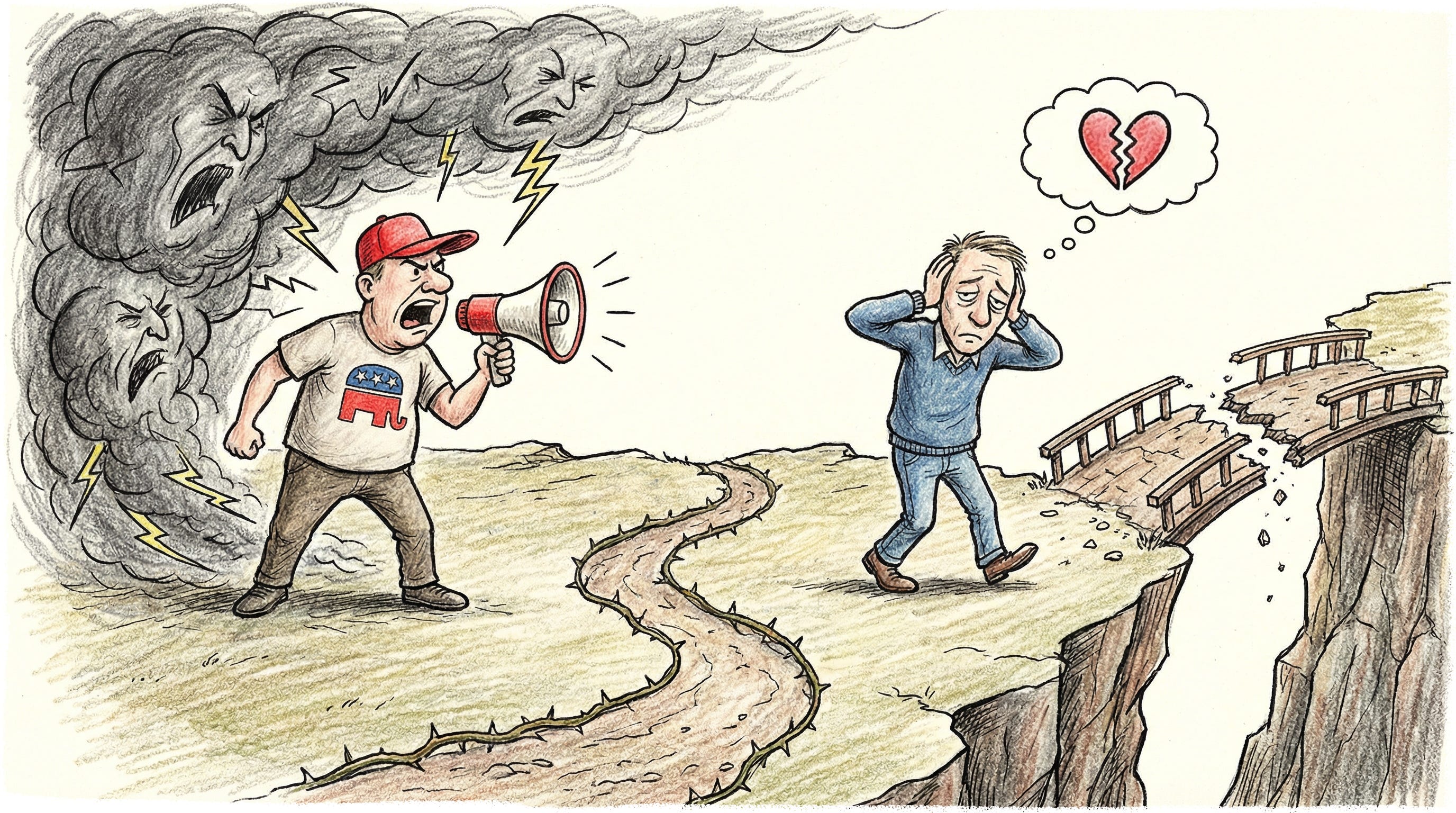
This is the third in a series of articles on dealing with friends and family caught in the clutches of the MAGA cult. If you missed them:
PART ONE: How to engage and gently de-program brainwashing.
PART TWO: How to navigate specific flashpoints (e.g., the Super Bowl) without blowing up.
But what happens when all of that isn’t enough—when the cost to your own heart, body, and relationships is simply too high?
This article isn’t about giving up too soon. It’s about discerning when continued engagement with toxic people is doing more harm than good to you, and sometimes even to them.
I recently encountered one of these moments when I had to decide whether to continue in community with a group of pastor friends who had once been as close as brothers, a lifeline for my faith during some of the most turbulent times of my life. Over the years, they had drifted deeply into the MAGA mindset, and my advocacy against it was putting increasing strain on our relationship. Despite my repeated attempts to maintain the bond, I reached the point where I had to ask whether the juice was still worth the squeeze.
Here is part of the process I used to decide whether to keep trying—or to cut my losses and let go.
QUESTION 1: Is the person currently reachable?
In my decision about whether to distance myself from my MAGA pastor friends—and in your decision about your friends and family members—we aren’t issuing eternal verdicts. When you set a boundary, you are not judging a person’s spiritual health, nor are you saying the friendship is over (or that the communication/interaction will always be shut off), you are simply saying that the relationship is no longer currently healthy or helpful.
But how do you know when that is the right next step?
Signs they may still be reachable:
They can tolerate small amounts of disagreement without exploding.
They show occasional flashes of doubt, discomfort, or “this feels like too much or too far.”
They still have relationships or activities outside the MAGA/church/media bubble and are not completely cut off from reality and truth.
They can show empathy for at least some of the people they’ve been told are “enemies” (e.g., “Well, I don’t agree with them, but I don’t want them hurt.”)
Signs they’re not reachable right now:
Every disagreement becomes an attack; they escalate quickly to yelling, insults, or threats.
They use dehumanizing language freely and double down when challenged.
They cut off or punish anyone who doesn’t fully align (“you’re dead to me,” “traitor,” etc.).
Their entire identity and daily routine are structured around MAGA media, groups, or leaders.
There is ongoing harassment, stalking, or intimidation of you or others.
From a clinical and pastoral perspective, these aren’t just differences of opinion or perspective; they’re signs that the person is in a level of emotional and ideological captivity that you alone cannot fix.
It is important to remember that you are never called by God to sacrifice your own mental health on the altar of futility.
In my situation, though, the situation was more complex. My friends did not exhibit most of these signs, though they were moving steadily in that direction. But there were other things to consider.
QUESTION 2: What is the impact on you?
You matter.
This shouldn’t need to be said, but you don’t need me (or anyone) to give you permission to set boundaries for your mental health. Many people who grew up in toxic religious systems have been conditioned to believe they must endlessly sacrifice themselves for the comfort and benefit of others.
“Jesus first. Others second, I’m third.”
Hogwash.
That atrocious line has been used to justify all kinds of abuse.
YOU matter, and it is important to consider a friendship’s impact on you.
Body:
How do you feel physically before and after contact with this person (tight chest, insomnia, dread, headaches)?
Emotions:
Do you leave interactions feeling small, ashamed, enraged, or numb most of the time?
Behavior:
Have you started isolating from others, second-guessing yourself constantly, or changing your plans to avoid their outbursts?
Spiritual/Values:
Do you feel like you're betraying your own deepest values (e.g., about human dignity, justice, nonviolence) just to keep the peace?
If contact with this person consistently leaves you feeling unsafe, diminished, or like a stranger to yourself, that’s not just “family drama” or a difference of opinion among friends. That’s harm.
And harm is a very valid reason to create distance.
QUESTION 3: Is there a way forward that isn’t all-or-nothing?
Life isn’t usually black and white; most of it is shades of glorious gray.
When possible, resisting binary thinking and offering gradients is helpful in our relationships. There are different levels of boundaries that we might deploy.
Light boundaries (for relationships with some hope)
Limiting topics (e.g., “I’m not discussing elections or immigration with you anymore.”)
Limiting time (e.g., shorter conversations or visits, scheduled calls instead of constant texting).
Choosing group settings over one-on-one when that feels safer.
Sample language to use: “I care about our relationship, and I’ve noticed when we talk politics, we both end up hurt. I’m not going to keep doing that. I’m happy to talk about work, family, and life, but not Trump, elections, or immigration.”
Moderate boundaries (when there is repeated harm but you want some connection)
No more staying in their home / letting them stay in yours.
No more following them on social media / engaging in comment wars.
Seeing them only at certain events, with an exit plan.
Sample language to use: “I’m not willing to be yelled at or insulted anymore. If that happens again during a call or visit, I’ll end the conversation and try again another time.”
Strong or permanent boundaries (when contact is unsafe or deeply damaging)
Block numbers / social media when harassment continues.
Do not attend events where they will be present, or leave if they begin targeting you or others.
Make a clear statement that you are stepping back indefinitely.
Sample language to use: “Our interactions have become consistently hurtful and unsafe for me. I’m going to step back from contact for the foreseeable future. I wish you well, but I need to protect my own well‑being for now.”
Boundaries are not a failure of love, nor are they an indication that you failed in some way. Boundaries are a way to love yourself, and sometimes boundaries are the best way to love others as well.
QUESTION 4: What if I feel grief or guilt? Am I abandoning them?
Feeling grief is probably a good thing, not a bad thing.
Grief in loss is a sign of love. We feel grief because we aren’t just losing the relationship as it is, we are mourning the person they used to be and the future that we hoped for. That is part of the reason why we hold on to toxic relationships for far too long, often past the point of self-harm.
We must let go of the lies that grief tells us in these moments:
“If I loved them enough, they’d change.”
“If I endured just a bit longer, some good would come of this.”
“Good Christians/friends/children don’t walk away.”
These are all unhealthy narratives, lies that we tell ourselves to try and shoulder the blame rather than shift it to the other person… the person who is truly at fault.
We can counter those unhealthy thoughts with healthier framing:
“I did not build the cage that they are currently in. I don’t have the key to unlock the cage and rescue them, and I am not obligated to live inside it with them.”
“Sometimes the most honest form of love is refusing to participate in harm—even if that looks, from the outside, like distance.”
“May I release what is not mine to carry. May I protect the part of me that still believes in dignity, justice, and mercy. May I love this person without letting their captivity become my own.”
QUESTION 5: How do I have a difficult boundary conversation?
Here are a few quick ideas for different situations or tones.
Calm and direct:
“I’ve tried a lot of ways to keep our relationship going despite our political differences. At this point, the way that you talk to me/others and the things you support are causing real harm. I need to step back. That may change in the future, but for now, less contact is what I need to stay healthy.”
If they’re religious:
“I believe that God cares about truth in what we say and support, and that he wants us to love our neighbor and protect them from harm rather than heap harm upon them. I’m going to honor that belief by not staying in conversations that damage my spirit, even if that doesn’t make sense to you right now.”
If you want to leave the door slightly open:
“If, in the future, you’re ever willing to talk without insults or dehumanizing language, and to consider the harm you’re doing, I’d be open to revisiting this. But I can’t keep doing what we’ve been doing.”
FINALLY: You are allowed to choose yourself
These moments aren’t easy.
You are allowed to decide that your mental health, your kids’ safety, your queer identity, or your basic sense of worth matters more than keeping the peace with someone who refuses to see you.
You are allowed to stop being the “sole rescuer.” If they ever find their way out, there will be signs on the path, including the memory that you once tried to reach them.
Rescuing someone from a cult is holy work—but so is rescuing yourself.
When you're a brown immigrant, and you married into a white MAGA family..... I have decided to put up boundaries, and have stopped contact both for my mental health but also, as they progressively continue to dig their heels in defense of what is happening, also for my physical health. What breaks my heart is seeing my husband keep trying to break through to them - unsuccessfully.